Welcome to the website of the Gospel Standard Strict Baptists
"For by grace are ye saved through faith; and that not of yourselves: it is the gift of God: not of works, lest any man should boast." (Ephesians 2. 8-9)
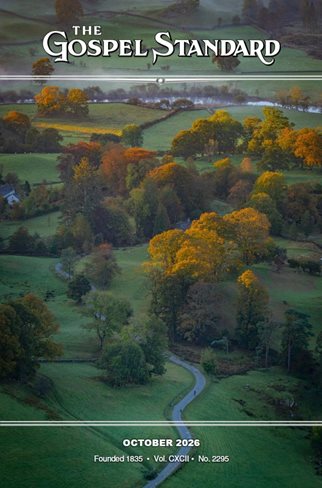
JULY 2026 CONTENTS
Editorial — The God of All Grace
Sermon — Confirming the Souls of the
Disciples (Acts 14:26)
Gospel Standard Society Meetings:
Afternoon Business Meeting Address
— The Image of God in Man (Genesis 1:26)
Gracious Counsel — Seeking God's Guidance
He Shall Direct Thy Paths
Love Removing Obstructions
Perplexing Paths
Why Study Church History?
Book Reviews
Matters of the Moment — A pet-Loving Nation
Poetry — Jesus the Good Shepherd
The Gospel Standard List
Cover image —
Path through a field of barley.
The God of All Grace
We are easily shaken by the appearance of sin in the church. Men and women fall into grievous sin. Divisions arise, separating chief friends. Enemies of the truth arise. People leave attending the house of God. We become confused and wonder if we know anything of the truth. The devil tempts us. We may personally sin. We are weak and ready to give up. The word which comforted us seems gone. Our religion feels dead. We think unbelieving thoughts of God. It seems easier to turn back than to continue.
Such experiences are sadly known by all the Lord’s people from time to time. The Word of God demonstrates that it has always been like this. The children of Israel came to the place where they said, “It had been better for us to serve the Egyptians, than that we should die in the wilderness.” When Elijah fled from Jezebel he “requested for himself that he might die.” The psalmist decided, “I will say unto God my rock, Why hast thou forgotten me? why go I mourning because of the oppression of the enemy?” In the New Testament some of the epistles show that those to whom they were written were similarly struggling, especially the letters of Peter.
Peter’s first epistle has been described as “a letter for hard times.” In closing it, Peter summarises his teaching in a prayer which takes for granted that in all our sufferings God is still being gracious and His purpose in our sufferings is always gracious. He prays, “The God of all grace, who hath called us unto his eternal glory by Christ Jesus, after that ye have suffered a while, make you perfect, stablish, strengthen, settle you.” He says a lot in a few words.
Firstly, Peter knows to whom he is praying: God is “the God of all grace.” He always has been, is, and will be the God of all grace. Everything God does for His people is gracious. They deserve only hell, but He spares, saves and gives glory. Yet when we are in trouble it is often hard to believe that God is gracious. It is a truth feelingly beyond our reach. This leads Peter to remind his readers of the evidences they have that God is the God of all grace.
God’s calling is gracious: “Who hath called us.” By nature we were vile and wretched sinners, God-haters, but in grace God did not leave us there. He has called us by grace. He has convinced us of our sin, made us cry to Him for mercy, and saved us. If you know what it is to be called by grace, you cannot doubt He is gracious. And Peter includes himself — “called us.” When we consider Peter, how Jesus called him to follow Him, and more pertinently, how Jesus re-called Peter to follow Him after Peter’s fall and denial of Jesus — it is grace, sheer grace! He told the women who came to His tomb, “Go your way, tell his disciples and Peter that he goeth before you into Galilee.”
God’s purpose is gracious. Peter fixes the attention of the suffering saints on the end to which they are called: “unto his eternal glory.” God has taken beggars from the dunghill to set them amongst princes. We are worthy only of being cast out of His sight, but He gives us a mansion in His house. He shares His glory with us. He shares it not just for a day, but for eternity. That is grace! It is the same thing that Paul points the Corinthians to in their affliction. Do not look at the things which are seen, Paul says, but look on the things which are unseen — an “eternal weight of glory” (2 Cor. 4:15-18).
God’s method is gracious. Peter reminds us that God calls us to glory “by Christ Jesus.” This calling and this gift of glory are not based on anything to do with us. It is not of works (we have nothing to bring). God has given His own dear Son to die for His people. By the work of Jesus a sinner is taken to heaven. It is all of grace!
Secondly, Peter acknowledges that the Lord’s people suffer. The world thinks that if God were good then there would be no suffering. But Jesus told His disciples, “In this world ye shall have tribulation.” A gracious God and sufferings are not incompatible. Yet the sufferings of the Lord’s people have a fixed end — “after that ye have suffered.” The sufferings of the lost have no end. At death, rather than ending, the real sufferings of the lost only just begin. The pains of hell will never cease. The sufferings of the Lord’s people have a certain termination point, and they contribute to their perfection.
Thirdly, Peter prays for their sufferings to accomplish something. “After that ye have suffered a while, [may God] make you perfect, stablish, strengthen, settle you.” This is what the God of all grace ultimately does for His people. He perfects that which concerns us (Psa. 138:8). He brings the third part through the refiner’s fire (Zech. 13:9) and will say “It is my people: and they shall say, The Lord is my God.” He will certainly bring his people to glory — their soul at death and their body at the great resurrection. No suffering on earth will prevent Him presenting His people faultless in glory with exceeding joy (Jude 24). In the light of glory, the sufferings of the Lord’s people here can only ever be described as for “a while” or as “our light affliction, which is but for a moment.”
But sufferings are not just a way for God to show His power in delivering His people from them. Instead, the purpose of the sufferings God leads His people through is their spiritual good now and preparation for final glory. Sufferings work for the good of the Lord’s people here and now. Peter prays that sufferings would “make you perfect, stablish, strengthen, settle you.” When the Holy Spirit sanctifies sufferings, they make us more fitted for heaven. They stablish us on the rock — they drive us to Jesus, prompt us to call on Him, induce us to go to Him, all bringing us to find our strength in Him. It was the thorn in the flesh that brought Paul the blessing of divine aid: “My grace is sufficient for thee: for my strength is made perfect in weak-ness.” That made Paul glory in his infirmities. Sufferings settle the Lord’s people on Christ and bring them to cast their all on Him. As Watts puts it:
A guilty, weak, and helpless worm,
On Thy kind arms I fall;
Be Thou my strength and righteousness,
My Jesus, and my all.
Are you shaken and ready to give up on God? May Peter’s words sink deep. May they strengthen you to keep going. We can pray to “the God of all grace,” who puts all that is wrong right. On the way to His eternal glory, we have to walk by faith and not by sight. May we cry for more faith to fix on the God of all grace alone, to trust Him for His grace in all our path here on earth, and to hope in this gracious outcome, “after that ye have suffered a while, make you perfect, stablish, strengthen, settle you.”
NOTICE: GS Trust Secretary Vacancy - a unique opportunity to serve the churches - please click
here for more details
A complete list of the books currently in print published by the Trust.
Information on legal matters regarding a chapel, assistance with complying with the law and help with carrying out repairs.
Information about the magazines published by the Gospel Standard Society. Subscriptions can be arranged here and sample copies downloaded.
Information about the Gospel Standard Bethesda care home at Brighton, and the Independent Living units at Harpenden and Swavesey.
Information about the Gospel Standard Society and its charitable aims.
Full details of the Gospel Standard Baptist Library. Catalogues of books can be downloaded and requests for books to borrow, free of charge, can be made.
Our Organisations
The Gospel Standard Trust has two primary functions:
- The publication of sound Christian books.
- To provide legal and financial assistance with Gospel Standard chapel buildings, and advice on complying with the law in other matters pertaining to the running of chapels.
The Gospel Standard Society:
- Provides financial assistance to those in need associated with the Gospel Standard chapels.
- Owns and publishes the Gospel Standard, Friendly Companion and Perception magazines.
The Gospel Standard Baptist Library maintains a valuable collection of Reformed Christian books.
The Gospel Standard Bethesda Fund provides care homes and warden-assisted flatlets for elderly people who are associated with Gospel Standard Chapels.
The Manuscript Sermons section is a new venture between the Gospel Standard Library and the Gospel Standard Trust to put on this web site scanned copies of most of the sermons which are in the possession of the Library in manuscript form. They can be freely downloaded. The project is still ongoing and it is hoped more will be added. Comments to the Librarian are welcome.
Who are the Gospel Standard Baptists? - A Summary
The Gospel Standard Magazine was originated by John Gadsby (1808-1893) in 1835 with the assistance and support of his father, William Gadsby (1773-1844) and is still published today. The magazine was commenced to contend for the doctrines of grace, but especially for the necessity and gracious, sanctifying effect of the work of the Holy Spirit in the hearts and lives of the Lord's people. It also advocated believer's baptism and strict communion. The circulation of the magazine grew rapidly, and in the early 1860s the editor, J. C. Philpot, gave a most gracious defence of the doctrine of the eternal Sonship of the Lord Jesus Christ, concerning which there had been many errors propagated, and which resulted in a division among the Strict Baptist churches. It was as a result of this division that many of the Strict Baptist churches began to align themselves with the Gospel Standard magazine, and over the years have become known as Gospel Standard Baptists.
For more information see the About Us page or download the booklet 'Who are We?" A list of Gospel Standard chapels can be downloaded here.